When people imagine the world’s most advanced data centres — the physical heart of the cloud — they often picture the sleek, high-tech buildings filled with servers, cooling systems, and fibre connections. Yet the foundation of every hyperscale data centre’s success begins not inside the building, but beneath it.
Before a single server rack is installed, before the steel is raised or the cooling systems are commissioned, a complex and highly technical phase of work takes place: groundworks.
At Salboheds Bygg & Anläggning AB, we’ve delivered groundworks for over 250 MW of hyperscale data-centre capacity across Sweden and the Nordics. We’ve learned that success starts with what happens below ground — and that mastering this phase can save millions in cost, months in schedule, and countless risks to safety and quality.
This article explores why groundworks matter so much for hyperscale data centres, what unique risks they carry, and how leading contractors like Salboheds mitigate them from the first shovel of soil to the final site inspection.
1. What “Groundworks” Really Mean in a Data-Centre Context
Groundworks are often misunderstood as simple earthmoving or “preparation” — but for data-centre developers, this stage sets the physical, structural, and operational integrity of the entire facility.
In the hyperscale world, groundworks typically include:
- Site preparation: clearing vegetation, demolishing existing structures, grading and levelling the site.
- Earthworks: excavation, backfilling, compaction, and creation of stable sub-bases that can bear heavy dynamic and static loads.
- Slab and foundation works: forming the base for buildings, equipment yards, and auxiliary structures that must meet millimetre-precise tolerances.
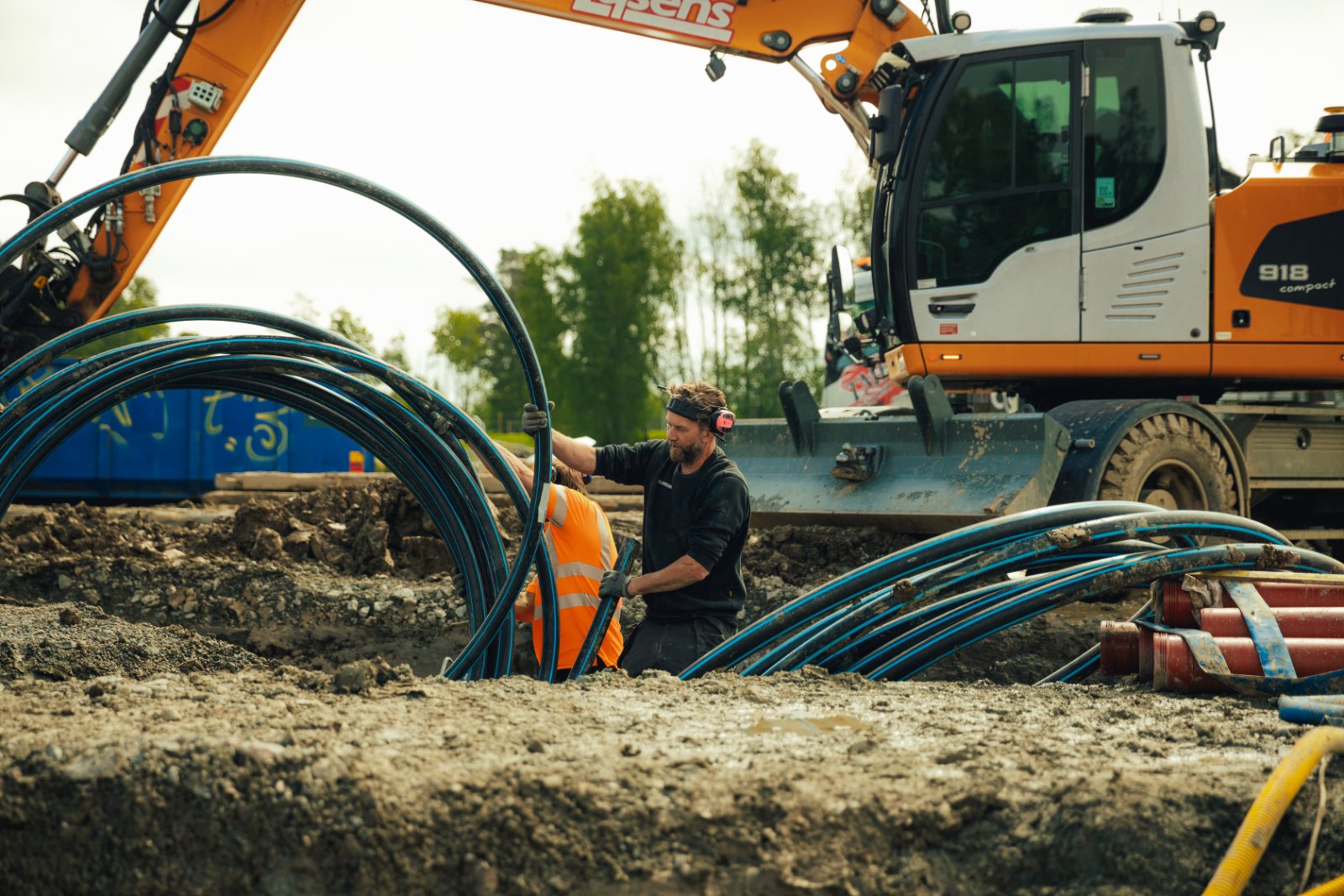
- Underground services: installing extensive networks of power, telecoms, fibre ducts, stormwater, sewage, and fire-water infrastructure — often kilometres of trenching and ducting with complex coordination.
- Roads and access infrastructure: enabling logistics during and after construction; building roads, parking, and laydown areas.
- Drainage and storm-water management: critical for sustainability, longevity, and environmental compliance.
Each of these elements is interconnected. If one is mis-timed, misaligned, or poorly executed, it can have cascading effects across the entire data-centre lifecycle. A single delay in underground utilities or a mis-compacted sub-base can stop follow-on trades, delay equipment installation, and create rework that compounds cost and schedule risk.
2. Why Hyperscale Data Centres Pose Unique Groundwork Challenges
Hyperscale projects differ dramatically from traditional industrial or commercial construction. They demand the precision of a semiconductor facility, combined with the scale of an airport and the speed of a logistics hub.
Below are the key challenges that make groundwork delivery for hyperscale data centres uniquely complex:
a) Extreme Schedule Pressure
Hyperscale operators — like Microsoft, Google, AWS, and Meta — operate under fierce time-to-market pressure. Every week of delay can cost millions in lost service capacity. Groundworks must be delivered faster, yet without compromising safety or quality.
At Salboheds, we’re often among the first teams mobilised to site, working within condensed programmes. Our coordination with multiple stakeholders — designers, geotechnical engineers, electrical utilities, and hyperscaler project managers — is critical to unlocking downstream activities.
b) Heavy Infrastructure Loads
Data centres are not lightweight structures. Their slabs must carry extraordinary point loads from battery systems, transformers, and cooling plants. Beneath the surface, ducts and conduits must be precisely aligned to ensure no clashes between power and telecom systems. Achieving the correct load-bearing capacity demands exacting geotechnical preparation and ongoing compaction testing.
c) High-Precision Tolerances
A hyperscale facility’s groundworks often require tolerances of ±5 mm for large-slab surfaces and accurate positioning of embedded conduits, anchor bolts, and drainage gradients. This precision is essential to ensure later installations — such as pre-fabricated units or MEP systems — fit perfectly.
At Salboheds, we use digital tools such as GPS machine control, 3D scanning, and BIM integration to verify tolerances and document progress in real-time.
d) Complex Utility Coordination
Few construction environments have such dense, interdependent utility networks as a data-centre site. Power, fibre, and cooling infrastructure run side-by-side, with strict separation requirements. Coordinating these utilities demands both engineering precision and logistical discipline. Mis-sequencing a trench or duct crossing can stop several trades for days.
Through integrated planning and daily coordination meetings, our teams manage hundreds of concurrent operations — ensuring safety, accuracy, and continuity.
e) Environmental & Climatic Challenges
In Nordic regions, harsh winters, frost, and groundwater levels present additional risk. Poor drainage or inadequate frost protection can lead to settlement, heave, or surface damage — issues that can threaten operations for years. Proactive hydrological studies and adaptive planning are therefore vital to long-term stability.
3. Salboheds’ Track Record – Building Confidence in the Ground
Salboheds is one of Sweden’s leading civil engineering partners for data-centre developments, combining the agility of a regional contractor with the capability of an international infrastructure partner.
Over the past decade, we have:
- Delivered groundworks for over 250 MW of data-centre capacity for hyperscale and enterprise clients.
- Supported sites for most major hyperscalers through trusted partnerships and subcontracting frameworks.
- Managed workforces of 1,500 + professionals and subcontractors across multiple concurrent civil packages.
- Delivered turnkey groundwork solutions — from virgin ground through earthworks, roads, utilities, and slab casting.
- Maintained an uncompromising focus on safety, sustainability, and schedule integrity.
This depth of experience means our teams understand both the macro-scale demands of hyperscale infrastructure and the micro-precision required for utility and foundation delivery.
Each Salboheds project benefits from our structured delivery process — from Initial Meeting → Planning & Start → Execution & Check-ups → Inspection & Follow-up — ensuring visibility, accountability, and consistent quality from first design to final hand-over.
For developers, this experience translates to reduced risk, predictable schedules, and peace of mind that their facility’s foundations — literally and figuratively — are secure.
4. The Top 5 Mitigation Strategies for Hyperscale Groundwork Success
Delivering data-centre groundworks safely, efficiently, and accurately requires more than technical expertise. It demands foresight — anticipating where risks arise and designing them out before they appear.
Here are the five key mitigation strategies Salboheds uses to de-risk complex groundwork programmes.
1. Early Engagement & Design Coordination
Risk: Late involvement of groundwork teams often leads to misaligned design assumptions, inaccurate quantity estimates, and rework once site conditions are revealed.
Mitigation: Salboheds advocates early engagement — ideally before the final design freeze. Working alongside designers and client engineers, we validate constructability, soil parameters, and phasing. This ensures that groundworks integrate seamlessly with the building and utility design, preventing future conflicts and delays.
Result: Early involvement can save 10–15% in programme duration and reduce change orders by up to 30%.
2. Comprehensive Geo-Technical & Hydro-Studies
Risk: Insufficient ground investigation leads to unforeseen conditions — soft spots, groundwater ingress, contaminated soils — causing redesign, downtime, or structural risk.
Mitigation: We commission or review detailed geo- and hydro-studies for every project, analysing soil bearing capacity, groundwater table, and frost depth. These studies inform excavation strategy, drainage design, and selection of materials. In cold climates, we employ frost-resistant fill materials and geotextiles to ensure long-term stability.
Result: Predictable performance of sub-base and reduced risk of post-construction settlement or water-logging.
3. Prefabrication & Modularisation
Risk: On-site congestion and schedule bottlenecks caused by simultaneous operations (civil, electrical, MEP).
Mitigation: Wherever possible, Salboheds leverages prefabricated or modular elements such as precast manholes, chamber systems, and utility corridors. These components reduce installation time, improve safety by limiting deep excavation exposure, and enhance quality control.
Example: At the Stackbo data-centre site, collaboration with Precast North allowed rapid installation of multiple utility chambers while maintaining safety and programme pace.
Result: 20–30% reduction in installation time and less on-site labour intensity.
4. Integrated Utility Coordination
Risk: Utility clashes, service rework, or missed connections between civil and MEP scopes.
Mitigation: Salboheds manages a fully integrated utility coordination process. Our site teams use 3D BIM models, clash detection, and daily coordination meetings with MEP contractors. Each trench, duct bank, and manhole is tracked through a digital model to verify alignment and separation.
Result: Fewer clashes, improved traceability, and faster hand-over to electrical and mechanical trades.
5. Safety-First Culture
Risk: Civil works are high-risk environments — heavy plant, open trenches, live utilities. Safety lapses can cause severe injury, downtime, and reputational damage.
Mitigation: Safety is the cornerstone of Salboheds’ culture. Our teams undergo mandatory inductions, toolbox talks, and ongoing refresher training. We implement strict permit-to-dig and isolation procedures, and maintain continuous supervision on-site.
We view safety not as compliance, but as performance protection — because safe sites are productive sites.
Result: Consistent record of low incident rates and zero lost-time injuries across recent data-centre projects.
5. The Future of Groundworks: Data, Digitalisation, and Sustainability
The groundwork industry is transforming. Digital tools are enabling real-time visibility, sustainability expectations are reshaping materials and methods, and collaboration between trades is stronger than ever.
At Salboheds, we are investing heavily in innovation — combining experience with digital transformation. Through our Innovation Office, we are integrating data analytics, drone mapping, and BIM workflows to enhance precision and accountability.
Sustainability is also at the heart of our evolution:
- We reuse excavated materials where possible to minimise transport and carbon impact.
- We adopt hybrid and electric plant equipment to reduce emissions.
- We integrate storm-water and soil management solutions that protect local ecosystems.
As hyperscale clients increasingly measure embodied carbon, these innovations in the groundwork phase can have an outsized impact on the overall footprint of a data-centre campus.
6. Lessons Learned – What Clients Should Know
From our experience across dozens of hyperscale projects, five consistent lessons emerge for developers and contractors alike:
- Start early. Groundworks define the pace of every subsequent trade. Engage early and plan collaboratively.
- Trust local expertise. Regional conditions — climate, soil, regulations — demand local insight.
- Don’t underestimate utilities. Underground services are often 30–40% of the groundwork scope and the most common cause of delay.
- Prioritise safety culture. The best-run sites are those where people feel safe, respected, and informed.
- Build for expansion. Hyperscale facilities evolve. Design groundworks with scalability in mind — additional ducts, conduits, or foundation pads cost little now but save millions later.
7. Conclusion: Getting Your Project Right from Day One
Groundworks are more than the start of construction — they are the foundation of operational reliability, long-term performance, and project success.
At Salboheds Bygg & Anläggning, we understand that for hyperscale data-centre developers, every hour counts and every detail matters. From initial soil analysis to final road surfacing, we bring precision, predictability, and partnership to the table.
Our record — over 250 MW of data-centre groundworks delivered, across some of the most challenging sites in the Nordics — proves one thing: the right groundwork partner makes the difference between meeting a deadline and missing an opportunity.
Let’s discuss how we can get your project right from day one.
Contact the Salboheds team →